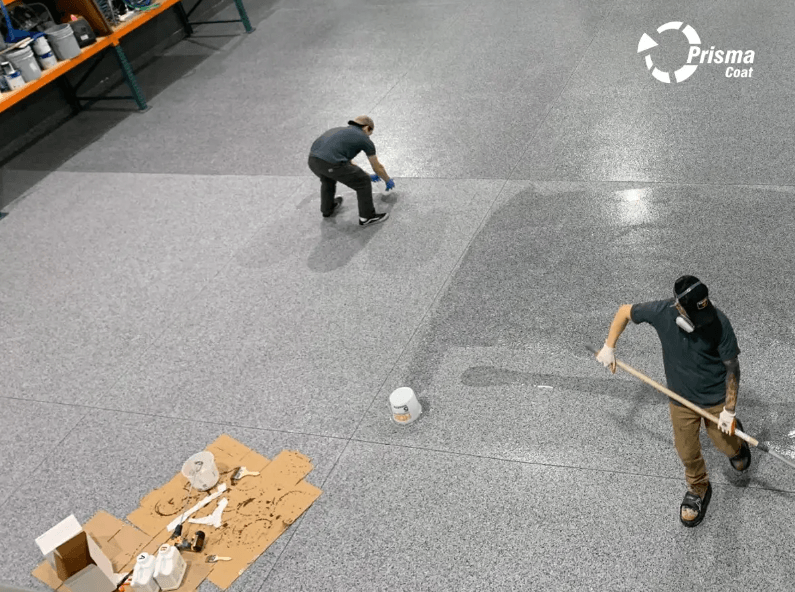

Industrial floor coating is rarely treated as a strategic decision. It gets lumped into the broader renovation budget, selected based on upfront cost, and handed to whoever is available to apply it. That approach costs facilities far more than the money saved at the point of purchase. The global industrial floor coating market was valued at approximately $6.70 billion in 2024 and is projected to reach over $10 billion by 2033. That scale of investment reflects how seriously high-performing facilities treat their floors. It also reflects how often the wrong choice gets made and needs to be corrected.
A coating that fails prematurely, degrades under chemical exposure, peels in high-traffic zones, or creates slip hazards does not just look bad. It generates safety incidents, triggers compliance violations, forces unplanned downtime, and damages the concrete substrate underneath turning a flooring decision into a facility-wide problem.
This blog explains exactly where those costs come from and why they consistently exceed what facilities expect.
What the Wrong Industrial Floor Coating Actually Means
Choosing the wrong industrial floor coating does not always mean buying a poor-quality product. It often means buying the right product for the wrong environment. A coating that performs excellently in a dry warehouse will fail quickly in a food processing facility where hot water washdowns happen daily.
A standard epoxy that works well under foot traffic will delaminate under continuous forklift movement. A coating applied without proper surface preparation will peel within months regardless of its technical specifications.
The wrong coating is any system that does not match the specific chemical exposure, thermal range, traffic type, moisture conditions, and regulatory requirements of the facility it is installed in. Industrial settings vary enormously.
A pharmaceutical facility need non-porous, chemically resistant flooring that supports sterile cleaning protocols. A battery manufacturing plant deals with sulfuric acid exposure. A food processing facility faces lactic acid, high-temperature steam cleaning, and constant moisture. Each of these environments requires a different system.
Installing a general-purpose coating in a specialized environment is one of the most common and costly mistakes in facility management.
Cost 1: Premature Failure and Recoating Expenses
The most direct financial consequence of the wrong industrial floor coating is premature failure, which means coating that peels, cracks, blisters, or delaminates before the end of its intended service life.
A coating specified and installed correctly should last seven to ten years in most industrial environments before requiring recoating. A mismatched or improperly applied coating can fail within one to three years.
The cost of recoating is not simply the materials and labor for the new application. It includes the cost of removing the failed coating, preparing the surface correctly, and addressing any concrete damage that occurred during the failure period.
Surface preparation alone accounts for a large share of coating project costs. A second round of preparation on a damaged substrate costs more than the first. Facilities that cut corners on application often pay far more in rework than they saved upfront.
Over ten years, a facility that recoats every two to three years due to repeated coating failures spends significantly more than one that invested in a correctly specified system from the start.
Cost 2: Unplanned Downtime
Floor recoating in an industrial facility is not a weekend job. It requires surface preparation, application, and curing time, all of which take the affected floor area out of operation. When a correctly specified coating reaches the end of its planned service life, recoating can be scheduled in advance and managed to minimize disruption. When a coating fails prematurely and unexpectedly, the downtime is unplanned.
Unplanned downtime is one of the most expensive events in industrial operations. Each hour of unscheduled downtime costs an average of $125,000 per hour across manufacturing industries globally. Even for smaller facilities, the disruption to production schedules, labor costs, and delivery commitments during an unplanned floor remediation adds up to figures that dwarf the original coating investment.
In round-the-clock operations, even planned recoating must be staged across zones to keep critical aisles and production areas open. When failure happens outside a planned window, that staging is impossible. Operations stop, work gets rerouted, and the downstream effects ripple through the facility for days.
Cost 3: Safety Incidents and Liability
Industrial floor coatings serve a direct safety function. They provide slip resistance in wet and oily environments, define traffic lanes and hazard zones with color markings, and create chemical-resistant surfaces that contain spills and prevent floor degradation. When the wrong coating is installed or an existing coating begins to fail, each of these safety functions degrades.
Slippery floors are a leading cause of workplace injuries. Slip, trip, and fall incidents account for a significant portion of all occupational injuries across manufacturing, warehousing, logistics, and processing facilities in Pakistan and globally.
When floor coatings lose their slip-resistant properties, either because the coating was not specified for wet conditions or because it has degraded, the injury risk increases directly.
A coating that cracks or peels creates uneven surfaces that become trip hazards. A coating that pools liquids due to inadequate slope or drainage failures creates fall hazards that compound over time.
The liability costs from a single serious workplace fall, including medical expenses, compensation claims, lost productivity, and potential legal proceedings, can reach significant figures.
When a pattern of incidents develops at the same location due to a persistent floor coating problem, the liability exposure compounds further. What looked like a minor flooring decision becomes a compensation claim, a regulatory inquiry, and a legal file.
Cost 4: Regulatory and Compliance Penalties
Industrial facilities in Pakistan operate under the Punjab Factories Act, the Sindh Factories Act, provincial labor inspection frameworks, and sector-specific standards for food processing, pharmaceuticals, and chemical manufacturing. Floor conditions that deteriorate, lose slip resistance, develop drainage problems, or allow liquid accumulation create direct compliance risk under these frameworks.
Labor inspectors visiting a facility with visibly degraded floor coatings, pooling liquids, peeling surfaces, soft spots, or uneven areas can issue improvement notices, halt production in affected zones, or recommend penalties under applicable labor and factory legislation.
For export-oriented facilities, international buyers conduct their own third-party audits. A failed floor condition in a food processing or pharmaceutical facility can result in the suspension of supplier status, a commercial consequence that far exceeds any cost savings made at the time of coating selection.
Facilities serving regulated sectors such as food export, pharmaceuticals, and chemical processing face the additional scrutiny of Pakistan Standards and Quality Control Authority requirements and international certification audits.
A coating not specified for a regulated environment can trigger findings across multiple compliance frameworks at once.
Cost 5: Concrete Substrate Damage
The floor coating is a protection layer. The concrete underneath is the structural asset. When the wrong coating fails and is left in a degraded state — cracked, peeling, allowing moisture and chemicals to reach the substrate. The concrete itself begins to deteriorate. That deterioration is a separate and significantly more expensive problem than the coating failure that caused it.
Concrete that absorbs chemical spills without a protective barrier suffers from pitting, scaling, and spalling. Moisture that penetrates through failed coating into the slab causes internal pressure buildup that accelerates cracking.
Forklift traffic on unprotected or poorly protected concrete causes surface wear that compounds with every pass. What begins as a coating failure becomes a structural repair.
Concrete repair and restoration in industrial facilities is far more expensive than proactive coating maintenance. Partial slab replacement in a working facility with the associated downtime, logistics, and structural work can cost tens of thousands of dollars for a modest area.
Full-section concrete restoration can reach six figures in large facilities. The coating was the inexpensive protection layer. Repairing what it was supposed to protect costs multiples of what the right coating would have cost from the start.
Cost 6: Hygiene and Contamination Failures
In food processing, pharmaceutical manufacturing, and laboratory environments, floor coatings are not just a durability consideration. They are a hygiene requirement. Seamless, non-porous coating systems prevent bacteria, mold, and contaminants from harboring in floor surface cracks and joints.
A coating that peels, cracks, or develops surface porosity creates contamination risk that goes directly to product quality, food safety compliance, and regulatory standing.
A single contamination event traced to floor surface conditions can trigger a product recall, a facility shutdown, or loss of certification. These outcomes generate costs that operate on a completely different scale from a coating replacement.
The food processing industry sees recall costs averaging in the millions of dollars per event, and contamination-related facility shutdowns eliminate production revenue for the entire duration of the closure.
For Pakistani exporters supplying food products to the European Union, the Gulf, or other regulated markets, a contamination finding linked to floor conditions can result in the rejection of entire consignments and the removal of export approvals.
In these environments, the wrong floor coating is not a maintenance problem. It is a business continuity risk.
Why Facilities Keep Making This Mistake
The pattern of wrong coating selection repeats itself for consistent reasons. Procurement decisions prioritize upfront cost over total lifecycle cost. Facility managers inherit existing coating decisions made by predecessors without the full context for why they were made. Application is assigned to contractors without coating-specific expertise. Surface preparation steps are shortened to save time and cost, undermining even a correctly specified product.
The epoxy segment alone is expected to reach $5.43 billion and grow at 7.7% annually through 2032, reflecting how dominant it has become as a default choice. Epoxy is an excellent coating for many applications.
It is not the right choice for every application. A facility where hot thermal cycling occurs daily, or where flexible substrates create movement, or where UV exposure is constant, conditions common across Pakistani textile, food processing, and chemical manufacturing plants, may perform significantly better with polyurethane or polyaspartic systems. Defaulting to epoxy because it is familiar, rather than specifying based on operating conditions, is one of the most common sources of premature failure.
How to Avoid These Costs
The starting point is an honest assessment of operating conditions before any coating is specified. This means documenting chemical exposures, thermal ranges, traffic types, moisture conditions, regulatory requirements, and cleaning protocols. Each of these factors narrows the appropriate coating system.
A specialist contractor should evaluate the concrete substrate for moisture content before recommending a system, because moisture in the slab is one of the leading causes of coating delamination, regardless of product quality. This step is especially relevant in Pakistan, where seasonal humidity variation, groundwater levels in industrial zones, and inconsistent slab curing practices can all affect substrate moisture.
Surface preparation must be treated as part of the coating project, not a preliminary step to rush through. The coating is only as durable as its bond to the substrate, and that bond depends entirely on how well the surface was prepared. Shot blasting, diamond grinding, crack repair, and moisture mitigation are the steps that determine whether the coating performs as specified or fails within the first year.
The coating decision should be evaluated on total lifecycle cost, installation, expected service life, maintenance requirements, and recoating frequency rather than upfront material cost alone. A coating that costs more at installation and lasts twice as long costs significantly less over ten years than the cheaper alternative that fails and requires emergency remediation.
See also: How to Change Your Existing Closet Into a Minimalist Capsule Wardrobe for
Final Words
The floor of an industrial facility is one of its most heavily used assets. It takes forklift loads, chemical exposure, thermal cycling, constant foot traffic, and daily cleaning all simultaneously.
A coating system that is correctly matched to those conditions protects the floor, protects the people working on it, and keeps the facility compliant and operational.
A coating that is mismatched to those conditions does the opposite, and the costs accumulate quickly across safety incidents, downtime, compliance penalties, substrate damage, and repeated remediation cycles.
The global industrial floor coating market is growing steadily, reaching over $10 billion by the early 2030s, reflecting how seriously high-performing facilities worldwide take this decision. For those still treating floor coating as a simple line-item purchase rather than a technical specification, the costs outlined here represent what that approach consistently produces. The right coating, correctly specified and properly applied, is always cheaper than the wrong one.


 By
By
 By
By